

There is a difference between a backyard and a place you want to disappear into.
The first might have a patio, a few chairs, a grill, and plenty of open space.
The second has a feeling.
You walk through the garden and find a chair beneath a tree. The patio seems to have its own little ceiling. Plants frame the view without completely blocking it. You can hear water somewhere nearby. The house feels a little farther away.
Nothing about it is necessarily enormous.
In fact, it may be quite small.
But it feels like a room.
That is the appeal of the backyard garden room—one of the most interesting directions in outdoor design right now. Landscape professionals are seeing growing demand for smaller, more intimate outdoor spaces designed as personal retreats rather than expansive showcase yards. The National Association of Landscape Professionals describes the shift as a renewed interest in “nooks” and traditional garden-room concepts: comfortable, enclosed-feeling spaces that give homeowners somewhere to retreat as well as entertain. The Edge NALP
And creating one doesn’t necessarily require a major landscape renovation.
It starts with a change in perspective.
Instead of asking, What should I put in my backyard?
Ask: What do I want this corner to make me feel?
A Garden Room Doesn’t Need Four Walls
The most beautiful outdoor rooms rarely have four actual walls.
They have edges.
A mature tree can become one wall.
A hedge can become another.
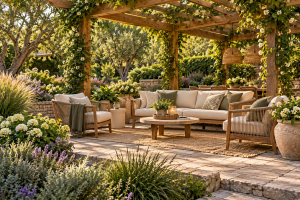 A pergola creates a ceiling.
A low stone wall establishes a boundary.
A change in paving tells you where the room begins.
Even a pair of large planters can be enough to create a sense of enclosure.
This is why garden rooms work particularly well in outdoor spaces. They give you the psychological comfort of a defined room while keeping the openness that makes being outside so appealing.
You can still see the sky.
You can still feel the breeze.
You can still hear the rest of the garden.
But you’re no longer sitting in the middle of everything.
Start With One Purpose
The mistake is trying to make every garden room do everything.
Instead, give each space a reason to exist.
Maybe yours is a morning coffee room.
A place to read.
A quiet spot for cocktails.
A poolside lounge.
A garden dining room.
A place for two people to sit after dinner.
Once you know the purpose, the design becomes much easier.
A reading garden needs a comfortable chair and good shade.
An outdoor dining room needs a table, circulation, and lighting.
A cocktail garden might need a small table and beautiful evening planting.
A post-dinner lounge needs comfortable seating and warmth.
The space becomes intentional without becoming complicated.
Use the Garden to Create the Walls
This is where landscaping becomes architecture.
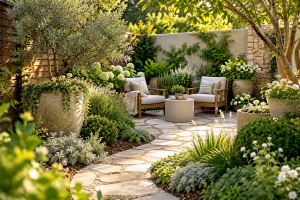
Imagine a small patio surrounded by layers of planting.
Closest to the seating: low groundcovers and perennials.
Behind those: ornamental grasses and flowering shrubs.
Behind those: taller shrubs or a small tree.
Suddenly, the patio has depth.
The garden isn’t simply surrounding the furniture.
It’s defining the room.
Layered planting is increasingly important in contemporary landscape design, with designers moving toward more naturalistic compositions, climate-adapted plants, and gardens that feel abundant rather than rigidly arranged. Meg & Kennedy Landscape Design
And that abundance can make even a modest backyard feel surprisingly private.
Give the Room a Ceiling
You don’t need to build a roof.
Sometimes the best ceiling is a tree.
A mature canopy immediately changes the scale of a space. Sitting beneath it feels different from sitting in an open yard.
Pergolas offer another option.
They create architectural structure without completely closing the sky.
Add climbing plants and the effect becomes softer.
A vine-covered pergola can feel almost like a secret passage into another room.
For warmer climates, a pergola can also become the foundation for an outdoor living space that provides shade while still allowing airflow. Modern pergolas and other shade structures are increasingly being used to create comfortable, flexible outdoor rooms rather than simply decorative structures. BPI Outdoor Living
The Furniture Should Encourage Staying
A garden room is not a furniture showroom.
The chairs should be comfortable.
 The table should be the right height.
There should be somewhere to put a drink.
And if you’re designing for longer evenings, there should be somewhere to put your feet up.
This is where outdoor furniture trends have become particularly interesting. The emphasis is shifting toward curved forms, mixed materials, tactile fabrics, and furniture arrangements that feel more like interior rooms than traditional patio sets. WestinTrends
Think about how you arrange furniture indoors.
You don’t generally push every chair against the wall.
You create conversation.
Do the same outside.
Let the Materials Connect to the House
The garden room should feel like it belongs to the property.
That doesn’t mean everything has to match.
But there should be a conversation between materials.
If the house has warm wood, repeat some of that tone in the pergola or furniture.
If the architecture uses natural stone, bring stone into the patio or garden walls.
If the interior is filled with warm neutrals, carry some of those tones outside.
This creates the visual continuity that makes indoor and outdoor spaces feel connected rather than separate. Current outdoor design is increasingly focused on extending the home’s material palette into the landscape, helping patios and gardens feel like natural extensions of the interior. Salisbury Landscaping
The goal isn’t matching.
It’s belonging.
Give the Eye Somewhere to Go
A garden room shouldn’t feel like a dead end.
Even a private space benefits from a view beyond itself.
Maybe the opening looks toward a flowering tree.
Maybe you can see the pool.
Maybe the room frames a garden path.
Maybe there is a glimpse of the sky beyond the pergola.
This is one of the secrets of good landscape design: enclosure becomes more interesting when it is paired with release.
You feel tucked away.
But not trapped.
Design for the Way the Day Changes
The best garden rooms have different personalities throughout the day.
In the morning, sunlight filters through the planting.
At midday, the pergola or tree provides shade.
In late afternoon, the garden catches warm light.
After sunset, landscape lighting changes the composition entirely.
That means lighting deserves to be considered from the beginning.
A softly illuminated tree can become the focal point.
Low path lights can define the edges.
A warm pendant can make a dining area feel intimate.
And leaving portions of the garden unlit creates depth.
The goal is not to light the whole room.
It’s to reveal it gradually.
Give the Evening a Center
There is something instinctive about gathering around a warm focal point.
In a garden room, that might be a dining table.
A water feature.
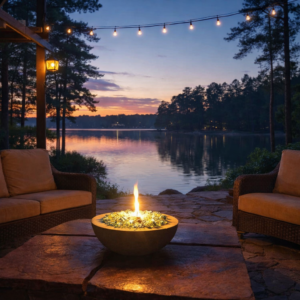 A fire bowl.
Our handcrafted concrete fire bowl can work especially well when the goal is intimacy rather than spectacle. Placed on a sturdy outdoor table and surrounded by comfortable chairs, a small flame creates a visual center for conversation while taking up very little space.
The fire becomes part of the room’s atmosphere.
Not the entire room.
And that distinction matters.
The garden is still visible.
The trees are still part of the experience.
The flame simply gives everyone a natural place to gather.
Fire features remain popular in outdoor design because they extend the usable evening and create a natural gathering point—particularly in smaller, more intimate outdoor spaces. Veranda
Don’t Forget the Sound
A garden room should engage more than your eyes.
Wind moving through grasses.
Leaves rustling overhead.
Water trickling from a small fountain.
Birds in the planting.
The subtle sound of conversation around the table.
These are the things that make an outdoor space feel immersive.
You can even use landscaping strategically to soften unwanted neighborhood noise.
Dense planting, walls, water, and the gentle sound of moving leaves can all contribute to a greater sense of separation.
The garden begins to create its own atmosphere.
The Smallest Backyard May Have the Best Garden Room
You don’t need acres.
In fact, smaller properties may benefit the most from this approach.
Instead of trying to make a small yard look larger by leaving everything open, create one beautifully defined destination.
A six-by-eight-foot patio.
A bench beneath a tree.
A tiny pergola.
A pair of chairs surrounded by planting.
One carefully positioned table.
When everything has a purpose, the space can feel generous.
This is part of why the move toward intimate outdoor rooms is so compelling. Designers are increasingly looking at the backyard not as one large entertaining platform, but as a collection of smaller experiences—places to dine, relax, garden, gather, or simply be alone. The Edge NALP
You don’t need more backyard.
You may simply need more intention.
Make One Place You Can’t Wait to Use
That’s ultimately what a garden room should accomplish.
Not impress your neighbors.
Not fill every square foot.
Not become another project you have to maintain.
It should create one place that makes you think:
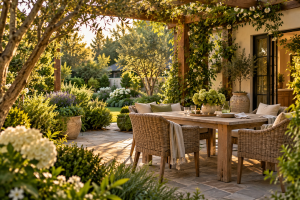 I want to sit there.
Maybe it’s first thing in the morning with coffee.
Maybe it’s late afternoon with a book.
Maybe it’s dinner with friends.
Maybe it’s ten o’clock at night, when everyone else has gone inside and you stay outside for another twenty minutes beside a little flame.
That is what makes a garden room worthwhile.
It gives the backyard a sense of destination.
And sometimes, the most beautiful outdoor spaces aren’t the ones that offer the most.
They’re the ones that make you want to linger.
FAQs
What is a garden room in landscape design?
A garden room is a defined outdoor space designed around a particular use or experience. It can be created with planting, walls, pergolas, paths, changes in paving, furniture, or other landscape elements rather than traditional enclosed walls.
How do I create a garden room in a small backyard?
Start with one purpose and define a compact area using furniture, planting, a pergola, containers, or a low wall. Layering elements vertically can create privacy and enclosure without consuming much floor space.
What plants are best for creating a garden room?
The best plants depend on your climate and conditions, but layered combinations of trees, shrubs, ornamental grasses, perennials, and groundcovers can create natural walls and ceilings while adding texture and seasonal interest.
How do I make an outdoor room cozy at night?
Use comfortable seating, warm layered lighting, and a focal point that encourages people to gather. Depending on the space and local requirements, an appropriate outdoor fire feature can add warmth, movement, and atmosphere.
While you’re here, check out our fire bowls! KP FireBowls handcrafts concrete fire bowls that are perfect for any outdoor space. Each fire bowl is hand poured and finished with your choice of glimmering fire glass.




0 Comments for “How to Create a Backyard Garden Room: The Secret to Making Outdoor Spaces Feel More Intimate”