

The first time you use an outdoor shower at home, it can feel slightly extravagant.
You’re standing beneath the open sky, warm water running over your shoulders, surrounded by trees instead of tile.
Then you realize something.
You don’t want to go inside.
That’s the real appeal of an outdoor shower.
It isn’t simply a convenient place to rinse chlorine from your hair or sand from your feet. Done well, it becomes one of those small luxuries that changes how you experience the entire backyard.
And unlike some outdoor upgrades, it doesn’t require a massive footprint.
A thoughtful enclosure.
A beautiful shower fixture.
A little privacy.
Some good landscaping.
Suddenly, a forgotten corner of the backyard becomes a destination.
The best outdoor showers aren’t designed as miniature bathrooms placed outside. They’re designed as part of the landscape—an experience that connects architecture, water, plants, privacy, and the feeling of being outdoors.
Start With the Ritual, Not the Plumbing
Before choosing tile or fixtures, think about how the shower will actually be used.
Is it beside the pool, where people can rinse off before coming inside?
Near a garden, where you might cool down after working outdoors?
Beside a guest suite?
Near a beach-access entrance?
Or tucked into a private corner of the backyard simply because you like the idea of showering beneath the sky?
The location should follow the ritual.
A poolside shower should make moving from water to patio effortless.
A garden shower can be more secluded and immersive.
A shower intended for everyday use needs a different kind of convenience than one designed primarily as an occasional outdoor indulgence.
Start there.
The design will follow.
Privacy Should Feel Natural
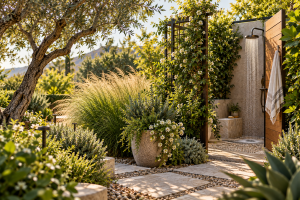 An outdoor shower needs privacy, but privacy doesn’t have to mean building a box.
This is where landscaping can become part of the architecture.
A dense hedge can create a living wall.
Tall ornamental grasses can soften an opening.
A trellis can support climbing vines.
A wood slat screen can block a direct sightline while allowing light and air through.
Large planters can create separation without permanent construction.
The best solution often combines several of these.
A solid screen on the side where privacy matters most.
Planting along the base.
A little openness above.
The result feels sheltered without feeling enclosed.
And because the plants are doing some of the visual work, the shower becomes part of the garden rather than an object dropped into it.
Let the Materials Get Better With Age
Outdoor showers are wonderfully suited to natural materials.
Stone.
Teak.
Cedar.
Concrete.
Terracotta.
Brass.
These materials develop character outdoors.
Wood weathers.
Stone changes subtly with moisture and time.
Metal develops patina.
Concrete gains texture.
Instead of trying to keep everything looking brand new, choose materials that become more interesting as they age.
That approach also connects an outdoor shower visually to the rest of the landscape.
A stone shower floor can echo the patio.
A cedar privacy screen can relate to a pergola.
A concrete basin can complement architectural elements elsewhere in the yard.
When materials repeat throughout the property, separate outdoor features begin to feel like one cohesive environment.
The Ground Beneath Your Feet Matters
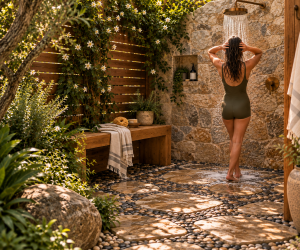 This may be one of the most overlooked parts of outdoor shower design.
You’re going to notice the floor.
Especially barefoot.
A beautiful shower can feel completely wrong if the surface is slippery, uncomfortable, or difficult to drain.
Natural stone with appropriate texture can create a spa-like feeling.
Teak slats can provide warmth underfoot while allowing water to drain.
Pebbles can create a more natural aesthetic when properly installed.
Large-format pavers can make the space feel architectural and contemporary.
Whatever material you choose, drainage and slip resistance should be part of the design from the beginning—not an afterthought.
Beauty matters.
So does what happens to the water once it hits the ground.
Give the Shower a View
This is where an outdoor shower becomes something entirely different.
Instead of facing a fence, position it toward something worth looking at.
A garden.
A mature tree.
A wall covered in climbing greenery.
A private courtyard.
Even a small planted area can become a beautiful focal point.
You don’t need an expansive view.
You need a beautiful one.
Imagine standing beneath warm water while looking at ornamental grasses moving in the breeze.
Or showering beneath a tree canopy while morning light filters through the leaves.
The shower becomes less about washing off.
It becomes about being there.
Bring the Garden Into the Shower
Plants can make an outdoor shower feel dramatically more luxurious.
But choose them for the actual conditions.
How much sun reaches the space?
How much moisture?
Is the area sheltered?
Will the plants tolerate occasional overspray?
In warm climates, lush tropical foliage can create a resort-like atmosphere.
In other regions, ferns, grasses, flowering shrubs, vines, and shade-loving plants may be more appropriate.
Fragrance is particularly wonderful here.
Jasmine.
Gardenia.
Lavender.
Mint.
Rosemary.
Whatever is suited to your climate and growing conditions.
A plant that releases fragrance when the air is warm can turn a practical shower into a sensory experience.
Don’t Forget the Small Luxuries
The difference between a functional outdoor shower and a memorable one often comes down to details.
A hook for a towel.
A small shelf for soap.
A place to hang a robe.
A bench.
A teak stool.
A built-in niche.
A weather-resistant basket.
Good lighting for early mornings or evenings.
None of these features needs to be elaborate.
They simply make the shower easier to use.
And because outdoor living is ultimately about how a space feels in real life, those practical details often matter more than expensive finishes.
Design for the Walk Back to the House
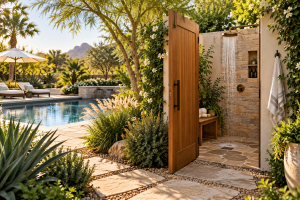 The shower itself isn’t the entire experience.
Think about what happens before and after.
Where do you leave your shoes?
Where does the towel go?
Is there a path from the pool?
Does the route become slippery when wet?
Can you move comfortably toward the patio without walking through a garden bed?
A beautiful stepping-stone path can turn the journey into part of the experience.
So can a row of low plants or subtle landscape lighting.
This is one of the recurring principles of good outdoor design: don’t design individual features in isolation.
Design the sequence.
Pool.
Shower.
Garden.
Patio.
Dining area.
Lounge.
Each space should lead naturally to the next.
Give the Shower a Second Life After Dark
Outdoor showers aren’t necessarily daytime spaces.
With thoughtful lighting, they can become part of the evening landscape.
A warm light near the entrance can make the shower easy to find without flooding the area.
Low landscape lighting can illuminate the path.
A softly lit tree can create a beautiful backdrop.
And beyond the shower, the rest of the backyard can take over.
Perhaps dinner is finishing on the patio.
Perhaps guests are moving toward a lounge area.
Perhaps a small concrete tabletop fire bowl has begun glowing nearby.
The fire doesn’t belong in the shower itself, of course. It belongs in the larger outdoor room—the gathering space where people settle once the practical parts of the evening are finished.
That contrast is part of the pleasure.
Cool water.
Warm fire.
Garden air.
A dark sky.
The backyard starts to feel like a private resort.
The Best Luxury Might Be Five Minutes Long
An outdoor shower doesn’t have to be grand.
It doesn’t need a huge enclosure or expensive stone.
Sometimes the most memorable version is remarkably simple.
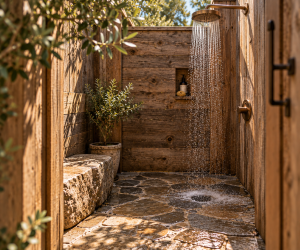 A weathered wood screen.
A beautiful showerhead.
A small stone floor.
A few plants.
A hook for a towel.
And enough privacy to forget, for five minutes, that you’re at home.
That’s what makes outdoor living so rewarding.
Luxury isn’t always about adding more.
Sometimes it’s about taking an ordinary activity and giving it a beautiful setting.
And once you experience that, the outdoor shower stops being an amenity.
It becomes part of the way you live.
FAQs
Is an outdoor shower worth adding to a backyard?
For homeowners who have a pool, spend significant time gardening, live near a beach, or simply enjoy outdoor living, an outdoor shower can be both practical and enjoyable. Its value comes from combining everyday convenience with a more immersive outdoor experience.
How do you make an outdoor shower private?
Use a combination of privacy screens, fencing, pergolas, trellises, curtains, large planters, and layered landscaping. The most effective designs usually block specific sightlines rather than enclosing the entire shower.
What is the best material for an outdoor shower floor?
The best material depends on climate, drainage, maintenance, and the overall design. Textured natural stone, appropriately treated wood, and other slip-resistant outdoor materials can work well when properly installed and drained.
Can an outdoor shower be used year-round?
That depends heavily on climate and plumbing design. In regions where freezing temperatures occur, outdoor plumbing generally requires appropriate winterization or specialized installation. In warm climates, an outdoor shower can potentially be used throughout the year.
While you’re here, check out our fire bowls! KP FireBowls handcrafts concrete fire bowls that are perfect for any outdoor space. Each fire bowl is hand poured and finished with your choice of glimmering fire glass.


0 Comments for “The Outdoor Shower, Reimagined”